
Slab Leak Signs Every Baton Rouge Homeowner Should Know
Why slab leaks are so common in Baton Rouge, the early warning signs to watch for, and what detection and repair actually costs.
GulfServicePros Editorial — pricing and licensing details cross-checked against LSLBC records before publication
Slab leaks are one of the most expensive plumbing problems a Louisiana homeowner can face — and Baton Rouge sees more of them than almost anywhere else in the state. The combination of clay-heavy soil, slab-on-grade construction throughout most subdivisions built since the 1960s, and seasonal moisture cycling all converge to produce slab leak rates that exceed national averages by a wide margin.
The good news: slab leaks have warning signs that show up well before any visible damage. Catching one early often means a $1,500-$3,500 repair instead of a $6,000+ disaster.
What a slab leak actually is
A slab leak is a leak in a water supply line that runs beneath your concrete foundation slab. Most slab leaks occur in the hot water line because hot water expands and stresses pipe joints faster than cold water — but cold water leaks happen too.
In Baton Rouge homes, slab-embedded supply lines are typically copper (in homes built 1965-1990) or, less commonly, galvanized steel (older construction). Both materials degrade over decades when surrounded by moist soil. Pinhole leaks develop, water escapes into the soil beneath the slab, and the leak slowly grows until it produces visible symptoms.
Unlike above-floor leaks, slab leaks don't show up as a puddle on a tile floor. The water travels along the slab, through the soil, and may surface ten or twenty feet away from the actual leak location — or may not surface at all and simply soak the soil.
Why Baton Rouge has more slab leaks than most cities
Three factors converge to produce Baton Rouge's elevated slab leak rate:
Clay-heavy soil throughout East Baton Rouge Parish. The dominant soil type is expansive clay that swells when wet and contracts when dry. Long Louisiana summers followed by autumn rain produce dramatic seasonal moisture cycling that physically stresses any pipe joint embedded in or beneath the slab.
Slab-on-grade construction is the dominant building style. Most homes built since the 1960s — across Mid City, Sherwood Forest, Tara, Shenandoah, and the I-10 corridor — sit on concrete slabs poured directly on the soil. Supply lines run through the slab.
The long warm season means hot water lines run more. Hot water systems work harder in Louisiana's long warm season than in cooler climates. Pinhole leaks in hot water copper lines develop faster as a result.
Six early warning signs
1. Unexplained increase in your water bill
This is the single most reliable early warning sign. A slab leak loses water continuously, 24/7, even when no one is using water in the home. The leak rate is usually too small to be visible but adds up to noticeable water loss over a billing cycle.
If your water bill jumped 20-50% with no change in household usage, suspect a leak somewhere — and if visual inspection of fixtures and accessible plumbing reveals nothing, suspect a slab leak.
2. Warm or damp spots on tile or concrete floors
If the leak is in the hot water line, the warm water heats the slab above it. Walking barefoot in the affected area, you'll notice a distinct warm spot — sometimes large enough to feel uncomfortably warm, sometimes subtle enough to only be noticeable in the morning before the floor has otherwise warmed up.
For cold water leaks, you may notice a cool damp patch instead.
3. The sound of running water when no fixture is on
Stand in the quietest part of your home with all water fixtures off. Listen carefully. A slab leak under significant pressure produces a continuous low hissing or running-water sound that's audible if you're paying attention.
This test is most reliable late at night when ambient noise is lowest.
4. Reduced overall water pressure
A significant slab leak diverts water that should be reaching your fixtures. The reduction in pressure may be subtle at first — a slightly weaker shower, slightly slower bathtub fill — but tends to grow over time.
This sign is more reliable when the change happens gradually over weeks rather than suddenly. Sudden pressure changes more often indicate a different problem (water main work, pressure regulator failure, fixture-specific issues).
5. Cracks appearing in walls or floors
Long-running slab leaks soak the soil beneath the foundation, which causes the soil to shift. The shifting soil moves the foundation, which causes hairline cracks in interior walls (especially around door and window frames) and floors.
By the time you see cracks, the slab leak has been going on for months or years. This is a late-stage warning sign that should trigger immediate professional inspection.
6. Visible water damage at the base of walls
In extreme cases, water from a slab leak migrates up through the slab edge and into baseboards, drywall, or flooring. You'll see staining, swelling, or visible moisture along the base of walls.
Like cracks, this is a late-stage sign that means significant damage is already occurring.
What slab leak detection actually involves
Professional slab leak detection in Baton Rouge runs $250-$650 and uses three diagnostic techniques in combination:
Pressure testing. Closing valves and watching whether pressure holds confirms a leak exists and isolates which section of the plumbing system is affected.
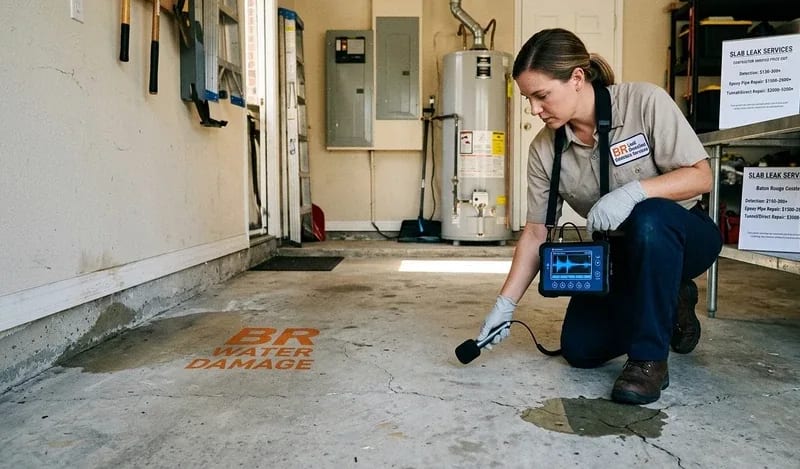
Acoustic listening. Sensitive microphones placed against the floor or pipes detect the sound of water escaping under pressure. Skilled technicians can pinpoint the leak location to within a foot or two.
Thermal imaging. Identifies temperature differences caused by hot or cold water leaks beneath floors. Particularly useful for confirming acoustic findings and ruling out false signals.
A proper detection job uses all three. If a contractor offers detection using only one technique, the results will be less precise and may lead to unnecessary cutting during repair.
What slab leak repair actually costs
Three main repair approaches, with widely different price points:
Re-route around the leak: $1,500-$3,500. The plumber routes a new pipe section through walls, ceilings, or attic space, bypassing the failed slab-embedded section. Works for most situations and avoids cutting the slab. Usually the best option when feasible.
Slab cut and direct repair: $2,500-$5,500+. Cutting through the slab to access the failed pipe directly, repairing it, then patching the slab. Disruptive but sometimes the only option.
Slab tunnel repair: $3,500-$8,000+. Tunneling under the foundation to access the leak from below. Used when re-routing isn't feasible and slab cutting would damage finished floors. Most expensive but least disruptive to interior finishes.
Most reputable Baton Rouge leak detection companies will credit some or all of the detection fee toward the repair if you proceed with the same contractor.
Should you suspect a slab leak right now?
If you're seeing one of the warning signs above, schedule professional leak detection within a week. If you're seeing two or more signs simultaneously, schedule within 48 hours.
Slab leaks don't resolve themselves. Every week that passes adds to soil saturation, foundation movement, and potential damage to interior finishes. Early detection genuinely saves thousands.
Ready to schedule slab leak detection?
GulfServicePros lists established Baton Rouge leak detection companies with ratings shown, so you can check each one's current Louisiana license yourself. Browse contractors for leak detection in Baton Rouge. For broader plumbing service, see plumbing repair in Baton Rouge.
Common questions
- What are the signs of a slab leak in Baton Rouge?
- Six common signs: unexplained increase in water bill, warm or damp spots on tile floors, sound of running water when no fixture is on, reduced overall water pressure, cracks appearing in walls or floors, and visible water damage at the base of walls.
- Why are slab leaks so common in Baton Rouge?
- Clay-heavy soil throughout East Baton Rouge Parish expands and contracts seasonally, stressing pipe joints embedded in the slab. Combined with slab-on-grade construction common in homes built 1960-90 and the long warm season, this drives elevated slab leak rates.
- How much does slab leak detection cost?
- Professional leak detection in Baton Rouge runs $250-$650. The diagnostic uses pressure testing, acoustic listening, and thermal imaging in combination to pinpoint the exact leak location.
- How much does slab leak repair cost?
- Re-route around the leak runs $1,500-$3,500. Slab cut and direct repair runs $2,500-$5,500+. Slab tunnel repair runs $3,500-$8,000+. Re-routing is usually the best option when feasible.
- Will my homeowners insurance cover a slab leak?
- It depends on your policy. Most standard policies cover sudden and accidental water damage caused by the leak but not the cost of detecting or repairing the leak itself. Review your policy and contact your insurer before scheduling repair.
- How fast should I act on suspected slab leak?
- If you see one warning sign, schedule professional detection within a week. If you see two or more signs simultaneously, schedule within 48 hours. Slab leaks don't resolve themselves and ongoing leaks cause foundation damage.
- Can I detect a slab leak myself?
- You can identify warning signs yourself but pinpointing the exact leak location requires professional acoustic and thermal equipment. DIY methods waste time and often lead to unnecessary cutting during repair. Always use a licensed leak detection specialist.
About this guide
This guide is filed under “Plumber” for Louisiana and Gulf Coast homeowners who want plain-language context before they call a licensed pro. Details in the body go deeper than a headline; any dollar figures or timelines are illustrative. Confirm scope and price in writing with the contractor you choose.