
Knob-and-Tube Wiring in Older New Orleans Homes: What You Need to Know
How to identify knob-and-tube wiring in your home, why it matters for insurance, and what remediation actually costs in Orleans Parish.
GulfServicePros Editorial — pricing and licensing details cross-checked against LSLBC records before publication
Knob-and-tube wiring is the original electrical system in many pre-1940 New Orleans homes — shotguns, doubles, Creole cottages, and Italianate townhouses across the Marigny, Bywater, Uptown, Mid-City, and Garden District. It's also become an insurance issue. Most homeowner's policies in Louisiana now require remediation of knob-and-tube before issuing or renewing, which has made this a frequent and high-stakes question for buyers, sellers, and existing owners of historic homes.
Here's what knob-and-tube actually is, how to know if you have it, what the safety reality looks like, and what remediation costs.
What knob-and-tube wiring is
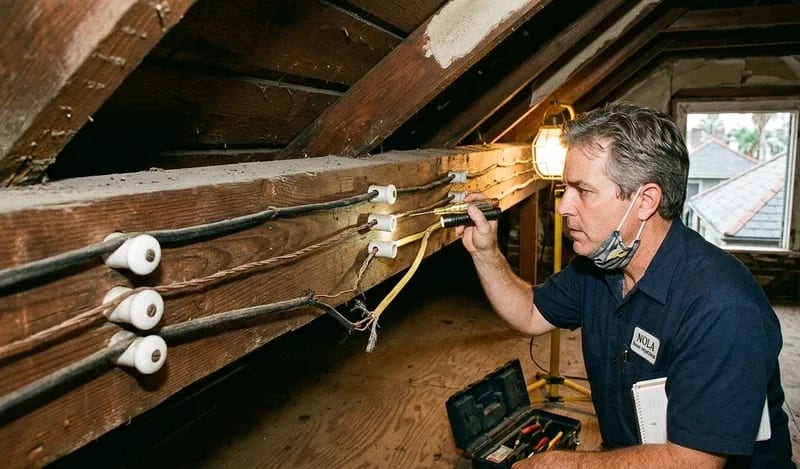
Knob-and-tube wiring (often abbreviated K&T) was the standard residential electrical system in the United States from the 1880s through the 1940s. The defining features:
- Two separate wires (one hot, one neutral) running independently through the home rather than bundled together in modern Romex cable
- Ceramic knobs that hold the wires in place where they pass through framing
- Ceramic tubes that protect the wires where they pass through wood (joists, studs, etc.)
- No grounding conductor — K&T predates modern grounding requirements by decades
- Cloth or rubber insulation on the conductors themselves, often with no protective sheath
In New Orleans homes, K&T is most commonly visible in unfinished attic spaces. You'll see two wires running parallel to each other (typically 6-12 inches apart), passing through the small white ceramic knobs and tubes characteristic of the system.
Is knob-and-tube actually dangerous?
This is the question that produces the most confusion. The honest answer:
K&T is not inherently dangerous in its original installed condition. When properly installed and undisturbed, it can operate safely indefinitely. The system was the standard for decades and millions of homes used it without incident.
K&T becomes dangerous when modified, overloaded, or compromised. And in nearly every century-old home, it has been one or all of the above:
- Insulation degradation. The cloth and rubber insulation on K&T conductors degrades over decades. Brittle insulation can crack and fall away, exposing live conductors.
- Overloading. K&T was designed for the electrical loads of the 1920s — a few light bulbs, maybe a radio, eventually an early refrigerator. Modern household loads (HVAC, microwave, multiple computers, EV chargers) wildly exceed what the system was designed to handle. Overloading produces heat, which accelerates insulation degradation, which increases fire risk.
- Modifications by previous owners. Decades of "I just need one more outlet" modifications by amateur electricians have introduced shortcuts, splices in wall cavities, and incompatible junctions throughout most older homes.
- Insulation contact. Modern blown-in or batt insulation in attics often surrounds K&T wiring. K&T was specifically designed to dissipate heat through air space — surrounding it with insulation traps heat and dramatically increases fire risk.
So: K&T in pristine, original, never-modified, never-insulated-around condition with light loading is functionally safe. K&T in real-world New Orleans homes — almost always modified, often overloaded, frequently surrounded by insulation — is a real fire risk that should be remediated.
How to identify K&T in your home
The reliable way: visual inspection of accessible wiring. Most New Orleans homes with K&T still have it visible in attic spaces. Look for the two parallel wires with white ceramic knobs and tubes described above.
The other reliable way: a licensed electrician's inspection. Any electrician with historic-home experience can identify K&T quickly. A pre-purchase or pre-renovation inspection ($200-$450) will tell you exactly what wiring is in the home, including hidden in walls.
Less reliable indicators that suggest K&T might be present:
- Two-prong outlets throughout the home (no ground)
- 60-amp electrical service or smaller
- Original fuse box rather than circuit breaker panel
- Home built before 1940
- No GFCI outlets in kitchens or bathrooms
None of these definitively confirm K&T, but together they point strongly toward it.
Why this matters for insurance
Most major homeowner's insurance carriers now treat K&T as either an automatic decline or a major risk factor requiring remediation before policy issuance or renewal. The specifics vary by carrier, but the general picture in 2026:
- Decline at any volume of K&T: Some carriers won't insure a home with any K&T present, regardless of condition.
- Decline if not remediated within X months: Many carriers will issue a policy with the requirement that K&T be remediated within 12-24 months.
- Surcharge but no decline: Some specialty carriers will insure K&T homes at a significant premium (typically 30-100% above standard rates).
- Standard rates with documented inspection: A few carriers accept K&T if it's been recently inspected, declared safe, and is not in contact with insulation.
If you're buying a New Orleans home with K&T, contact your insurance carrier before closing. Discovering after closing that you can't insure the home you just bought is a routine and avoidable disaster.
What remediation costs in New Orleans
Three main approaches:
Whole-home rewiring: $8,500-$25,000+ for a typical 1,500-2,500 sq ft home. Replaces all wiring with modern Romex, includes new outlets and switches throughout, typically includes panel upgrade. The most expensive but also the only approach that completely resolves the issue.
Partial rewiring (K&T circuits only): $4,500-$15,000. Replaces only the K&T circuits while leaving any modern wiring in place. Faster and cheaper than whole-home rewiring; satisfies most insurance requirements as long as no K&T remains active.
Selective remediation (K&T plus insulation contact issues only): $2,500-$7,500. Removes K&T from areas where it contacts insulation, may include some circuit upgrades. Cheapest option but may not fully satisfy insurance requirements depending on your carrier.
All three approaches require Orleans Parish permits and inspections. Historic district homes additionally require Vieux Carré Commission or Historic District Landmarks Commission review for any visible exterior electrical work (meter relocations, exterior fixtures).
Choosing a contractor for K&T work
K&T remediation in historic New Orleans homes is genuinely specialized work. Three things to look for:
1. Master electrician licensing through the LSLBC. Verify at lslbc.louisiana.gov. K&T work requires a master electrician — journeyman electricians can do the labor but a master must pull permits and supervise.
2. Documented experience with historic homes. Plaster walls and historic millwork require gentler work than drywall construction. Inexperienced crews can do thousands of dollars in unnecessary finish damage. Ask for references on similar-vintage homes specifically.
3. Coordination with your insurance carrier. A good contractor will work with your insurer to confirm what specific scope of work satisfies their requirements. This avoids paying for more remediation than you actually need.
Living through K&T remediation
Whole-home rewiring of a New Orleans historic home typically takes 5-15 working days. Living in the home during the work is possible but disruptive — power will be off in sections during work, walls will be opened, and dust is unavoidable. Many homeowners arrange to be elsewhere for at least the most invasive portion of the work.
For partial remediation work, the disruption is correspondingly less but still significant for the affected portions of the home.
Ready to schedule electrical inspection or remediation?
GulfServicePros lists established New Orleans electrical companies with ratings shown, so you can check each one's current Louisiana license yourself. Browse contractors for wiring and rewiring in New Orleans or electrical repair in New Orleans. For new installation work like dedicated circuits or panel upgrades, see electrical installation in New Orleans.
Common questions
- How do I know if my New Orleans home has knob-and-tube wiring?
- Visual inspection of accessible attic space is the most reliable way — look for two parallel wires (6-12 inches apart) running through small white ceramic knobs and tubes. Indicators that suggest K&T may be present: two-prong outlets throughout, 60-amp service, original fuse box, home built before 1940.
- Is knob-and-tube wiring dangerous?
- K&T is not inherently dangerous in pristine, original, never-modified condition with light loading. In real-world century-old homes — almost always modified, often overloaded, frequently surrounded by attic insulation — it is a real fire risk that should be remediated.
- Will insurance cover a New Orleans home with knob-and-tube?
- Most major carriers now require remediation before issuing or renewing policies. Some decline outright, some require remediation within 12-24 months, some charge significant surcharges. A few specialty carriers accept K&T at standard rates with recent inspection. Contact your carrier before buying.
- How much does knob-and-tube remediation cost in New Orleans?
- Whole-home rewiring runs $8,500-$25,000+. Partial rewiring of K&T circuits only runs $4,500-$15,000. Selective remediation (K&T plus insulation contact issues) runs $2,500-$7,500. All require Orleans Parish permits and inspections.
- How long does whole-home rewiring take?
- Typically 5-15 working days for a 1,500-2,500 sq ft New Orleans home. Living in the home during work is possible but disruptive — power off in sections during work, walls opened, dust unavoidable. Many homeowners arrange to be elsewhere for the most invasive portion.
- Can I do knob-and-tube remediation in stages?
- Yes. Many homeowners address K&T in priority order: insulation contact issues first, then high-load circuits (kitchen, bathroom, HVAC), then remaining circuits over time. Confirm with your insurance carrier that staged remediation meets their requirements.
- Do historic district rules affect rewiring?
- Yes. Vieux Carré, Marigny, Bywater, parts of Uptown and other historic districts require additional review by the Vieux Carré Commission or Historic District Landmarks Commission for any visible exterior electrical work — meter relocations, exterior fixtures, conduit runs visible from the street.
About this guide
This guide is filed under “Electrician” for Louisiana and Gulf Coast homeowners who want plain-language context before they call a licensed pro. Details in the body go deeper than a headline; any dollar figures or timelines are illustrative. Confirm scope and price in writing with the contractor you choose.