
Fall HVAC Tune-Up: Why Louisiana Homes Need One Before Winter
Why Louisiana's short heating season makes fall tune-ups counterintuitively important — and what a $100-$200 service catches before it becomes a no-heat emergency.
GulfServicePros Editorial — pricing and licensing details cross-checked against LSLBC records before publication
Louisiana's heating season is short — 30 to 50 days per winter where temperatures drop below 40°F — and that's exactly why a fall HVAC tune-up matters more here than in colder climates. The system sits idle 9-10 months a year, accumulating dust and developing problems that don't show up until you actually turn on the heat. By then, the first real cold snap of the year is producing a wave of no-heat emergency calls and contractors are days behind.
This is the case for spending $100-$200 in October to avoid a $600-$1,000 emergency call in January.
Why Louisiana heating systems fail at the start of winter
The failure pattern is opposite to northern climates. In Minnesota, furnaces fail from constant use over a 6-month heating season. In Louisiana, they fail from disuse over a 9-10 month idle season.
For gas furnaces: dust accumulates on the blower wheel, the heat exchanger, and the pilot or ignition components. Spider webs and small rodent activity in the burner area is common. When you finally turn the system on in November or December, the dust and debris produce: weak airflow, ignition problems, flame sensor failures, and in extreme cases dangerous burner conditions.
For heat pumps: the reversing valve — the component that switches the system between cooling and heating modes — can stick after months of cooling-only operation. The defrost cycle controls may also have developed issues that don't affect cooling but matter for heating performance.
For both: the air filter is almost always overdue for replacement, the thermostat may have battery or calibration issues, and the system's overall performance has typically degraded slightly since the last service.
What a proper fall tune-up actually includes
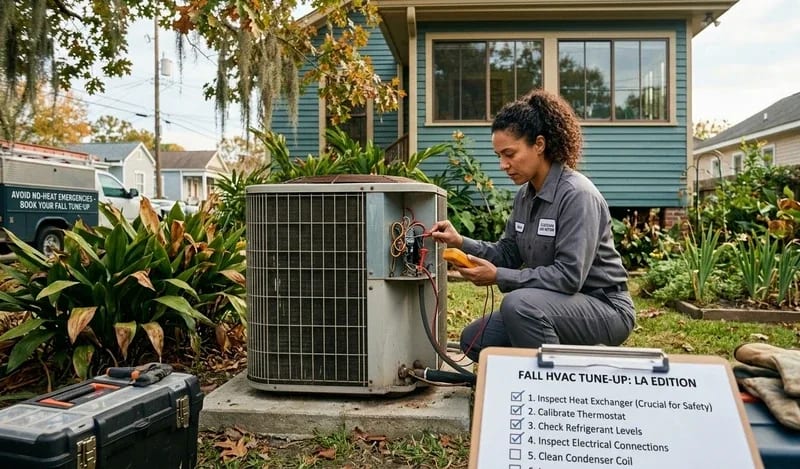
A standard heating tune-up in Louisiana runs $90-$200 and should cover all of the following:
For all systems:
- Air filter inspection and replacement (filter cost separate)
- Thermostat operation test and battery replacement
- Blower motor and wheel inspection
- Electrical connection inspection and tightening
- Refrigerant level check (heat pumps)
- Condensate drain inspection
- Operational test in heating mode for 15+ minutes to confirm steady-state operation
For gas furnaces additionally:
- Heat exchanger inspection (cracked heat exchangers are a CO poisoning risk and require immediate replacement)
- Burner cleaning and inspection
- Pilot or ignition system test
- Flame sensor cleaning
- Gas pressure verification
- CO detection in supply air
For heat pumps additionally:
- Reversing valve operation test
- Defrost cycle test
- Outdoor coil inspection (after the cooling season this often needs cleaning)
If your tune-up takes less than 60-75 minutes, the technician likely cut steps. A thorough tune-up takes time.
When to schedule
Best window: late September through October. This is when contractors have full availability, scheduling is quick, and you can address any issues found before the cold weather arrives. Most companies run promotional pricing during this window.
Acceptable: November. Still before peak heating demand, but lead times are starting to lengthen. You may have less choice of appointment time.
Late: December. First cold snaps of the year bring the wave of emergency calls. Tune-up scheduling competes with repair calls for technician time. Pricing may be higher.
Worst case: January-February. During an active cold snap, emergency repair calls take priority and tune-up scheduling can wait 2-3 weeks. By this point, if your system has issues, you're calling for emergency repair, not preventive tune-up.
What gets caught at fall tune-up
The most common issues found and fixed during fall tune-ups, roughly in order of frequency:
- Dirty air filter. Restricts airflow, hurts efficiency, can cause secondary issues.
- Dust accumulation on blower wheel. Causes weak airflow and noisy operation.
- Weak or failing capacitor (heat pumps). Easy fix during tune-up; left alone, becomes a no-heat call.
- Flame sensor needs cleaning (gas). Causes intermittent shutdowns when the system can't verify the flame is lit.
- Condensate drain partially blocked. Causes water damage in extreme cases, system shutdown in mild cases.
- Loose electrical connections. Cause intermittent operation that gets blamed on other components.
- Refrigerant level slightly low (heat pumps). Catches developing leak before it affects performance.
- Thermostat issues. Battery, calibration, or wiring problems that masquerade as system problems.
Most of these add 15-30 minutes to a standard tune-up and are included in the base price. Anything beyond standard scope (e.g. capacitor replacement, refrigerant top-off, drain clearing) is quoted separately at standard repair rates.
What a tune-up doesn't catch
Fall tune-ups are preventive maintenance, not full diagnostic services. A few things they don't reliably identify:
- Slowly developing compressor issues. Compressors often fail without much warning.
- Ductwork leakage. Requires specific ductwork testing equipment.
- Indoor air quality issues beyond dust on visible components.
- Sizing problems. A tune-up doesn't evaluate whether your system is the right size for your home.
For any of these, a separate diagnostic appointment is appropriate.
Tune-up plans and service contracts
Many Louisiana HVAC companies offer annual maintenance plans bundling spring and fall tune-ups. Typical pricing: $180-$350 per year for both visits. Often includes:
- Both spring (cooling) and fall (heating) tune-ups
- Priority scheduling during peak season
- Discount on any repair work needed
- No service-call fee for emergency calls
For most homeowners with systems older than 5 years, these plans pay for themselves through the priority scheduling alone. Getting prioritized for a no-heat call during a cold snap when other customers are waiting 3-5 days is genuinely valuable.
When to skip the tune-up
Two scenarios where fall tune-up doesn't make financial sense:
-
System under 2 years old and still under manufacturer warranty. First-year service is typically included in the purchase. Read your warranty terms.
-
System scheduled for replacement within 12 months. No point spending $150 on a system you're replacing in spring.
For every other situation, the tune-up math is favorable: $100-$200 in October beats $600-$1,000 emergency call in January, especially when you factor in the inconvenience of being without heat during a cold snap.
Ready to schedule a fall tune-up?
GulfServicePros lists established HVAC companies across Louisiana, with ratings shown so you can judge for yourself. For tune-up and repair service, browse heating repair in Baton Rouge. For New Orleans area service, see HVAC installation in New Orleans. For Jefferson Parish homeowners, see heating repair in Terrytown, heating repair in Harvey, or the Kenner directory. For duct cleaning as part of your fall service, see how often to clean air ducts in Louisiana.
Common questions
- When should I schedule a fall HVAC tune-up in Louisiana?
- Late September through October is the best window. November is acceptable. December begins to compete with emergency call scheduling. January-February tune-ups get pushed behind active cold-snap repair calls.
- How much does a fall HVAC tune-up cost?
- Standard tune-ups in Louisiana run $90-$200. Should take 60-75 minutes minimum. Annual maintenance plans bundling spring and fall tune-ups run $180-$350 per year.
- Why do Louisiana heating systems fail at the start of winter?
- Heating systems sit unused for 9-10 months per year, accumulating dust on blower wheels, heat exchangers, and ignition components. When the system finally runs in winter, dust and debris produce weak airflow, ignition problems, and flame sensor failures.
- What should a heating tune-up include?
- Air filter, thermostat test, blower inspection, electrical connection check, refrigerant level (heat pumps), condensate drain, and 15+ minute operational test in heating mode. Gas furnaces additionally need heat exchanger inspection, burner cleaning, flame sensor cleaning, and gas pressure verification.
- Are HVAC maintenance plans worth it?
- For systems older than 5 years, generally yes. Plans bundle spring and fall tune-ups with priority scheduling during peak season. The priority scheduling alone pays for the plan during cold snaps when other customers wait 3-5 days for service.
- When should I skip a tune-up?
- Skip if your system is under 2 years old and under manufacturer warranty (first-year service is typically included), or if you're replacing the system within 12 months.
- What's the difference between a tune-up and a diagnostic service call?
- A tune-up is preventive maintenance — cleaning, inspection, minor adjustments, basic operational tests. A diagnostic service call is responsive — investigating a specific problem you're experiencing. Tune-ups catch developing issues; diagnostics identify the cause of current symptoms.
About this guide
This guide is filed under “Hvac” for Louisiana and Gulf Coast homeowners who want plain-language context before they call a licensed pro. Details in the body go deeper than a headline; any dollar figures or timelines are illustrative. Confirm scope and price in writing with the contractor you choose.