
How Often Should You Clean Air Ducts in Louisiana? The Honest Answer
What the national guidelines miss — and what Louisiana's climate actually requires
GulfServicePros Editorial — pricing and licensing details cross-checked against LSLBC records before publication
The national recommendation for air duct cleaning is "every 3 to 5 years." That guidance was written for the average American home in the average American climate. Louisiana is not average. The combination of subtropical humidity, frequent flooding, older housing stock, and a cooling season that runs nine to ten months a year creates conditions that can make ductwork a serious indoor air quality problem on a much shorter timeline.
Here's what the evidence actually says, what Louisiana's specific conditions change about that guidance, and how to tell whether your ducts need cleaning now or can wait.
The honest baseline: it depends more on your home than the calendar
The NADCA (National Air Duct Cleaners Association) guideline of cleaning every 3–5 years is a reasonable starting point for a sealed, well-insulated modern home with a clean bill of health. Most Louisiana homes don't fit that description.
For Louisiana homes specifically, a more useful framework is cleaning based on conditions, not a fixed calendar interval. The conditions that shorten the timeline significantly:
Any flooding or water intrusion. This is the most important Louisiana-specific factor. If your home experienced any water intrusion — Katrina, Rita, Ida, a roof leak, a burst pipe, or any flooding event — the ductwork should be professionally inspected and very likely cleaned. Mold growth inside ductwork is not always visible from registers and doesn't announce itself until it's circulating spores through the home's air supply. Post-flooding duct cleaning isn't optional maintenance; it's a safety measure.
Humidity above 60% consistently in living spaces. Louisiana's ambient outdoor humidity is high, but properly functioning HVAC systems maintain indoor humidity at 45–55%. If your indoor humidity is routinely above 60% — which happens with oversized systems that short-cycle, systems with significant duct leakage, or systems with failing dehumidification — the ductwork interior is at elevated mold and microbial growth risk. Check with a basic hygrometer ($15–$25 at any hardware store).
Homes built before 1985 with original ductwork. Pre-1985 ductwork in Louisiana is frequently fiberglass duct board — a material that degrades, sheds fibers, and becomes an excellent surface for microbial growth in humid conditions. Original ductwork in an older Kenner ranch home or a 1970s Chalmette slab house should be inspected if it's never been cleaned, full stop.
Any renovation work in the past 2 years. Construction dust — drywall particles, insulation fibers, wood dust — is drawn into return air intakes during renovation and accumulates in ductwork. Major renovations without duct protection almost always produce significant contamination.
Pets, especially multiple pets or heavy shedders. Pet dander and hair accumulate in ductwork at a faster rate than dust alone. Homes with multiple pets typically reach cleaning thresholds in 2–3 years rather than 5.
When the 3–5 year guideline actually applies
The longer interval is reasonable for:
- Homes built after 2000 with sealed metal ductwork in conditioned spaces
- No history of flooding or water intrusion
- Indoor humidity consistently maintained at 45–55%
- No recent renovation work
- No pets or one light-shedding pet
- Previous professional duct cleaning within the past 3 years
If your Louisiana home checks all of these, cleaning every 3–5 years is appropriate. If it checks fewer than four, lean toward the shorter end of that range or toward condition-based inspection.
How to tell if your ducts need cleaning now
Four things you can check yourself:
Remove a supply register and look inside with a flashlight. You should see clean metal (or clean fiberglass duct board). Visible dust accumulation more than a quarter-inch thick, any dark streaking or spotting, or visible debris indicates cleaning is overdue.
Check your air filters. If you're replacing air filters monthly or more frequently because they're heavily loaded, your ductwork is probably contributing to that load. Filters catch particles returning to the system from inside the ductwork as well as from the living space.
Notice the air coming out of registers when the system first starts. A puff of visible dust when the blower kicks on is a reliable indicator of significant duct accumulation.
Track allergy or respiratory symptoms. Louisiana's outdoor allergen load is already high — oak and other pollen, mold from humidity. If household members are experiencing more respiratory symptoms than expected for the outdoor season, or symptoms concentrated indoors (better outside, worse inside), contaminated ductwork is a legitimate suspect.
What professional duct cleaning costs in Louisiana
Professional air duct cleaning in Louisiana runs $300–$550 for a standard 3-bedroom home with a single-system installation. Larger homes or homes with two HVAC systems run $450–$900+. Prices in New Orleans, Kenner, and the north shore are broadly similar — the job takes the same time regardless of geography.
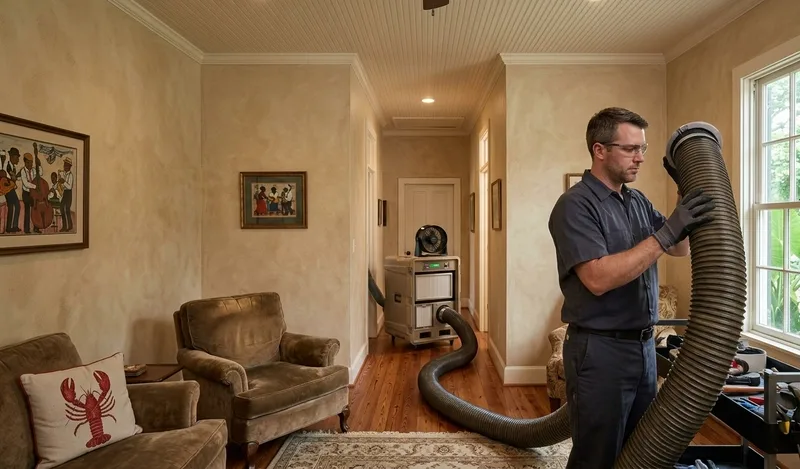
What a legitimate cleaning job includes: negative pressure containment (the technician connects a high-powered vacuum to the duct system before opening any registers, so contaminants go into the vacuum rather than the room), cleaning of all supply and return registers, brushing or air-whipping the duct interior, and cleaning the air handler coil and blower wheel if included in scope.
What you don't want: a $99 "special" that involves a shop vac, no negative pressure containment, and a 45-minute visit for a 2,000 sq ft house. Legitimate duct cleaning on a standard home takes 2–4 hours.
Post-flooding duct cleaning: what's different
If your ductwork was exposed to floodwater, standard cleaning is not sufficient. The protocol is different:
- Inspection first. Assess whether the ductwork can be cleaned or needs replacement. Fiberglass duct board that was submerged is typically not cleanable and should be replaced.
- Antimicrobial treatment. Metal ductwork that was flooded requires application of EPA-registered antimicrobial agents after cleaning, not just mechanical cleaning.
- Mold testing. Post-treatment air quality testing confirms the mold load has been addressed before the system is put back into service.
Reputable contractors doing post-flood duct work in Louisiana will include all three steps. The total cost for a flooded home's duct system is typically $800–$2,500+ depending on duct type, home size, and the extent of contamination.
Duct cleaning vs. duct sealing: not the same thing
One important distinction: duct cleaning removes contaminants from inside the ductwork. Duct sealing addresses leakage — the joints and seams in the duct system where conditioned air escapes before reaching the living space.
Both matter in Louisiana, but they address different problems. Cleaning improves air quality. Sealing improves system efficiency and can reduce humidity infiltration into the duct system (leaky ducts in attics draw in hot, humid attic air, compounding the humidity problem inside the duct).
If a contractor offers duct cleaning without mentioning duct condition, ask specifically about leakage. In older Louisiana homes, ductwork with significant seam leakage should be sealed as part of any system improvement project.
Verified air duct cleaning contractors near you
For Kenner and Jefferson Parish homeowners, air duct cleaning in Kenner lists local companies including Southland Air Conditioning & Heating, Tegridy Air AC & Heating, and Stanley Steemer — all with real Google review histories in the local market.
For New Orleans and the surrounding area, see the New Orleans contractor directory for the full list of verified air duct cleaning specialists.
For Chalmette and St. Bernard Parish, see air duct cleaning in Chalmette. On the West Bank, air duct cleaning in Terrytown and air duct cleaning in Harvey list companies serving those neighborhoods.
Common questions
- How often should air ducts be cleaned in Louisiana?
- In Louisiana, condition-based inspection is more useful than a fixed interval. Homes with any flooding history, persistent high indoor humidity, original pre-1985 ductwork, or recent renovation work should be inspected sooner than the national 3–5 year guideline. Homes with newer sealed metal ductwork, no flooding history, and controlled indoor humidity can follow the 3–5 year standard.
- How much does air duct cleaning cost in Louisiana?
- Professional air duct cleaning in Louisiana runs $300–$550 for a standard 3-bedroom single-system home. Larger homes or dual-system homes run $450–$900+. Legitimate cleaning takes 2–4 hours with negative pressure containment — be cautious of $99 specials that take under an hour.
- Should I clean my ducts after Hurricane flooding?
- Yes, and standard cleaning alone is not sufficient for flooded ductwork. The proper protocol includes inspection to determine if ductwork can be cleaned or needs replacement, mechanical cleaning, EPA-registered antimicrobial treatment, and post-treatment air quality testing. Fiberglass duct board that was submerged typically needs full replacement.
- How do I know if my air ducts need cleaning?
- Remove a supply register and look inside with a flashlight — more than a quarter-inch of visible dust accumulation, any dark spotting, or visible debris indicates cleaning is overdue. A puff of dust when the blower first starts, rapidly loading air filters, and indoor allergy symptoms worse than the outdoor season warrants are also reliable indicators.
- What is the difference between duct cleaning and duct sealing?
- Duct cleaning removes accumulated contaminants from inside the duct system and improves air quality. Duct sealing repairs leaks at joints and seams in the ductwork that allow conditioned air to escape — and in Louisiana attics, allow hot humid air to enter the duct system. Both matter, but they address different problems and should be evaluated separately.
About this guide
This guide is filed under “Hvac Tips” for Louisiana and Gulf Coast homeowners who want plain-language context before they call a licensed pro. Details in the body go deeper than a headline; any dollar figures or timelines are illustrative. Confirm scope and price in writing with the contractor you choose.